Showing posts with label Art Camp. summer camp. Show all posts

Monday, June 20, 2011

Art Farm Sculptures Inspired by Deborah Butterfield


Art Farm Summer Camp Season is off to a great start! Last week our middle school-age students studied Deborah Butterfield, an American artist known for her larger-than-life-sized sculptures of horses made from found objects such as metal and wood. Students watched a short video of her work, in which Butterfield talks about her technique and her life as an artist.

Following the video, students set about collaboratively creating primitive, larger-than-life sized sculptures of Art Farm's very own alpacas, Harry Potter and Mr. Weasley. The goal was to use as few tools as possible. Other than a ball of twine, all materials were found within Art Farm's habitat. Art Farm Instructor Andrew Sinclair, an accomplished sculptor himself, used the lesson to teach art concepts including the roles of negative space, tension, and texture in creating a 3-dimensional work of art.

Pictured here is a Butterfield sculpture (top) and the alpaca sculptures (bottom). Click on the images to see a larger view. 

Deborah Kay Butterfield
!Palomino Horse by Deborah Butterfield


Thursday, March 24, 2011

The Mighty Zeus and Why Students Should Learn to Draw With Charcoal


At the college-level, studio art students learn to draw and paint from life using human models. At Carlsbad Art Farm, we use farm animals as our models and each year we acquire new animals for this purpose. We strive for a variety, and when possible, we like to rescue animals.

My first goat, a Nubian mix, was bought for $20 at the local humane society. We now have alpacas, a mini-mule, a variety of chickens, two dogs, and others. Here is our most recent arrival, a baby Nigerian Dwarf Goat named Zeus. Zeus came to us at less than a week old as a bottle baby (for some reason his mom wasn't letting him nurse), requiring six bottle feedings daily, each bottle containing 2-ounces of milk.

Zeus is now six-weeks old and drinks four bottles of 8-ounces daily, supplemented with goat feed, orchard hay, and alfalfa. He is full of himself. He loves playing with our rescue shepherd, going for walks on a leash, and practicing his head butting on our ankles. He has already started modeling for students.
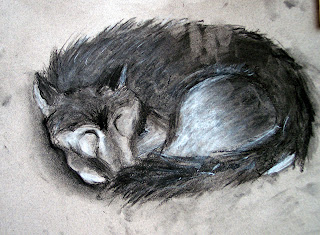
Wolf in charcoal by Rose, Age 11
One of the challenges for students drawing animals from life is that animals move, unlike human art models who are paid to pose absolutely still. It's an interesting challenge. So what do you do? Well, animal artists develop visual memories of the animals they draw. Once the initial gesture line is committed to paper, and if they have an understanding of the animal's anatomy and how it moves, then they work from both the living model and memory. Additionally, they can use photographs as visual aides. Most animal artists have a library of books on animal anatomy. As with any discipline, the more you practice, the better you get.

The wolf drawing above (be sure to click on images to get their full effect), by Rose, Grade 5, started out as a drawing from a black-and-white photograph of a wolf. She then used our German Shepherd as a live model (alas, we do not have an actual wolf at Art Farm), as a source for more realistic hair texturing, rendering of volume, and rendering of detail in the eyes, muzzle, and so on. The animal really lifts off the page.

So why not just work off of photographs exclusively and skip the problems inherent in drawing an animal from life? For one, photographs flatten 3-dimensional objects and this shows in drawings made exclusively from photos. Also, the drawings look static, as if you were drawing something with no life in it. This is fine for buildings, but undesirable in an animal drawing where the goal is to render a flesh-and-blood creature. Obviously not everyone has a farm full of animal models, so working from photos is certainly a good option. But almost everyone has access to a dog, or cat, or zoo. My daughter, 12, and I have visited the zoo for years just to park in front of an animal and draw. She gets lots of compliments from passersby, and this encourages her as an artist.

Wolf Head in charcoal by Brian, Age 9
In my experience teaching children, the best medium for learning to draw animals is charcoal. It is fun to use, very forgiving, and "painterly." It gets students away from working in sharpie and pencil, which are not "loose" mediums. A good animal drawing avoids being wooden and instead captures a sense of the animal's movement, making it appear more life-like.

Charcoal is an excellent medium for doing precisely this. It encourages experimentation with texture, smudges, and line quality. It is great for creating atmosphere around the animals. Smudges and lines can be used to create a sense that the animal is in a woods, or that the time of day is early morning or dusk, without literally drawing a coloring book-style tree next to the animal with a cartoon-ish sun in the sky. These effects can be used to create perspective to great effect.
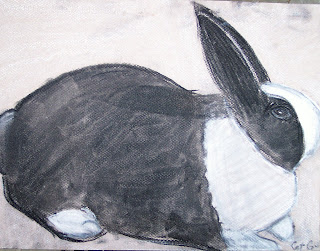
Rabbit in charcoal by Samantha, Age 9
Like no other medium, charcoal is very helpful for teaching the concept of value in drawing and painting. Understanding value and it's uses is the gateway to more sophisticated drawing and painting

For example, the bunny at left has a sense of volume, created by how the charcoal is laid down on the paper. The shifts in value are subtle in the dark and light areas of the animals body, but those shifts are why the animal seems three dimensional. Also, the animal's form is not completely encased in a hard, dark line all around the contours of the body. The line width and value alters, sometimes disappears, and this is what makes the image exciting to look at. Also, the shadow thrown by the bunny's ear lets the viewer know there is a sun in the sky, slightly off center of the animal, without drawing a distracting circle with squiggly lines depicting rays of light. While this is wonderful in a preschool or early primary school drawing, it is empowering for a developing young artist to tap into more complex "artist's tricks."
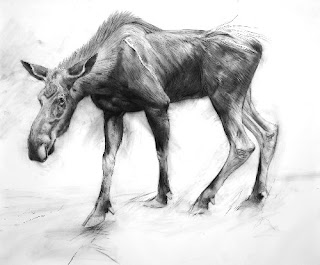
Moose Walking, Charcoal, by Canadian Artist Geordie Millar
At right is an outstanding example of an animal rendered in charcoal by Canadian artist and art professor Geordie Millar.

The drawing, from a series titled "Moose Walking", is huge (76X60). The image beautifully showcases the artist's understanding of the animal he was drawing, from life, in the Canadian wilderness. It also showcases the great versatility of charcoal as a medium: the velvety textures juxtaposed against hard lines to suggest the softness of the animal's fur while clearly showing the hard lines of its underlying anatomy; the smudging to create atmosphere and a sense that the animal is moving through space; the rich blacks that pencil cannot match; and again, the "painterly" quality of the image. This moose, to me, looks like a living, breathing, entity. When I view the student charcoal drawings above, I can see they are starting to pick-up on the concepts that Millar, as a mature artist, exhibits so masterfully. Imagine what might happen if these young students kept at it!

The "Moose Walking" series, and an equally breathtaking study of two horses by Millar titled "Procession", are nicely presented as a slide show on Millar's website.

Carlsbad Art Farm is now enrolling for summer camp 2011. Visit our website today for information and enrollment forms. And while your visiting our website, click our Facebook Page icon, and then click "like" to become a fan of our Facebook Page. As a fan, you will receive notifications of classes, seminars, discounts,  Art Farm BBQs, and such. We don't post all that much (we, at Art Farm, are too busy taking care of all the critters to post too much and, when we do, we usually include cute pictures of animal models - like Zeus!)


For questions about Art Farm, send us an email and we will get back to you shortly.

Friday, March 18, 2011

Get Connected to Carlsbad Art Farm Events!

Carlsbad Art Farm summer art and natural science camp enrollment is underway! For information and registration, visit our website or contact us.

Student Drawing, Grade 5
Whether you are new to Art Farm, or one of our many fans, or a teacher, we recommend that you become a follower on our blog (click icon, lower left) to receive kid-friendly postings about our animal friends at Art Farm and information about great websites and blogs by artists, museums, and other Internet resources, for kids, teens, and adults. We sift through what's out there so you don't have to.

Art Farm Outdoor Studio Drawing Class
If you are on Facebook, we also recommend that you visit our Art Farm Facebook Page and click the "Like" icon. Art Farm Facebook Page members will receive notifications of discounts, ongoing and new art classes, special events such as the Spring Art Farm Family BBQ, and other animal/art oriented postings. Art Farm won't annoy you with overly frequent posts. We just want to get occasional info to you and delight you with short missives and animal pictures from the Art Farm front. Give it try. You can always Unlike us.

To sign-up for the Art Farm Facebook Page, visit our website, click the Facebook icon, and then click the "Like" Icon. That's all there is to it.

Girl Scout getting kiss from Art Farm's Hairy Potter
At this time, we do plan to continue our Saturday morning Art class during the summer. Art class is from 9:30 A.M to Noon. Instruction makes use of live animal farm models to teach traditional drawing technique. Class is open to students in Grades 2-8. If you are not certain your child would like our class, we allow one-time class audits for $25.

Carlsbad Art Farm, recently featured in Carlsbad Magazine, Ranch & Coast Magazine, The Coast News, and the La Jolla Patch, as a premier destination for summer camp-bound youth,  is proud to be a 2010 Nickelodeon Parents' Pick Nominee. We are also proud of supporting local schools and organizations, such as Rady's Children Hospital, through our annual silent Auction donations of a week at Carlsbad Art Farm Summer Camp.

Sunday, March 13, 2011

Second Annual Project Wildlife Baby Shower Event


If you enjoy cute baby animals and birds, and supporting wildlife rescue and conservation, don't miss Project Wildlife's Second Annual Wildlife Baby Shower this coming Saturday, March 19, 2011. The event begins at 10 A.M. and continues to 4 P.M.

Project Wildlife, a non-profit dedicated to the rescue and rehabilitation of orphaned and injured wildlife, is located in San Diego at 887-1/2 Sherman Street, just off Sea World Drive Exit 21, toward Tecolote Road.

The event is free to the public and no reservations are necessary. Visitors will be treated to a behind-the-scenes tour of Project Wildlife's intake center, meet many of Project Wildlife's animal ambassadors, enter drawings for great prizes, sample cuisine from the Cohn restaurant group's mobile food truck, "Ms. Patty Melt," and shop for arts and crafts all hand-made by Project Wildlife's army of dedicated volunteers.

Carlsbad Art Farm Owner/Director Perrin Weston Coman is a former Project Wildlife home rehabilitator on the duck team.

Care Center tours are not recommended for pregnant women or immune compromised individuals. For all the information you need to attend the event, or about Project Wildlife, click here.

Wednesday, June 23, 2010

Art Farm Camp Sessions Update


Art Farm Summer Camp 2010 morning into afternoon sessions that are now closed are as follows:
  • Session 4 (July 5-9)
  • Session 5 (July 12-16)
  • Session 6 (July 19-23)
  • All late afternoon sessions (2 PM to 5 PM)
There is still time to enroll in all other sessions including Session 3, beginning next week, Monday, June 28. Sessions are one week and continue through mid-August. For information and enrollment forms, visit our website and click on the "Camp" tab.

Friday, April 23, 2010

Carlsbad Art Farm Summer Camp Registration Ongoing

This post is an Art Farm Summer Camp FAQ, so here goes:

Q: How do I register my child for camp? A: Easy! Visit our website at www.CarlsbadArtFarm.com; click on the "Camp" tab; scroll down to the bottom and download the registration form.

Q: When do camps begin and how long are they? A: Camps are one week and we have two sessions daily to choose from (9 AM - 1 PM and 2 PM to 5 PM). Dates and times (plus a whole bunch of other information) are posted at our website. Camps begin June 14 and continue weekly through mid-August.

Q: Is there still room in the session of my choice? A: When sessions fill, we will immediately post that information on this blog. Unless otherwise stated here, there is still room in the session of your choice. Traditionally, our heaviest enrollment period begins in late April and continues throughout the summer. If your camper wants to attend with friends, we recommend enrolling early to be sure there is space for your group.

Q: Is there an age requirement for attending camp? A: Students must be entering Grades 2 through 8 in fall 2010 to attend?

Q: Are younger kids in separate classes than older students? A: Absolutely! Art Farm's outdoor studio classrooms on 10-acres allow us to conduct three classes simultaneously in small groups. While older students are taking painting class, a middle-range group might be taking drawing, while the youngest group is working on a multimedia project. These groups rotate throughout the camp day so that the art instructor can teach according to the age-level of his or her group.

Q: I have a middle-schooler. Will there be other middle school students in my child's session? A: As we get closer to the first day of camp we will be able to answer that question better. You may always ask by emailing me (Perrin Weston Coman) at director@CarlsbadArtFarm.com. We have had many middle-school students come with friends and they have a blast.

Q: What is that large-eyed animal staring out at me from this post? A: That's Hairy Potter, one of our resident alpacas. He can't wait to see you this summer!

Tuesday, April 20, 2010

Spring Chicks Coming to Art Farm

Carlsbad Art Farm has placed it's spring chick order for summer camp. Arriving May 17 are 31 day-old chicks: Silver Polish (pictured here); Golden Polish; Buff Laced Polish; Barred Rocks; White Crested Polish; Black Polish; and Light Brahmans.

Our daughter, Emerson
, 11, is the resident chicken expert at Art Farm. She did all the ordering at McMurray Hatchery, assuring us that kids will especially love the Polish hens for their fabulous feathers.

The chicks, believe it or not, arrive care of our local post office. After pick-up, they are placed in brooders to keep them warm and safe until they are ready for the outdoors.

The polish variety are known for their wonderful feathered heads. Students will learn how to hold baby chicks and wash their hands after handling birds. Older students may enjoy learning how to bathe and blow dry a chicken for show.

Chickens at Art Farm are free-range during the day. They enjoy roaming our 10-acres woodland habitat for bugs, worms, and weeds. Students are delighted when the chickens cruise by during art classes. While doing so, they help fertilize and turn-over our soil. At night time, they all voluntarily return to their coop to roost. All of our birds are inoculated against disease.

Weekly camp sessions begin June 14 and continue through Mid-August. We offer two sessions daily to accommodate busy families. Students must be entering Grades 2 through 8 in Fall 2010 to attend. All classes are small and grouped according to age. Art projects are geared toward the age level of each student group.

We are located off El Camino Real and College Blvd. very near the Village of Carlsbad and Palomar Airport. Students come to Art Farm from all over north San Diego County. For more information visit our website and click on the "Camp" tab. Registration forms are available for easy download under the Camp Tab. You may contact us directly at director@carlsbadartfarm.com.

Sunday, February 28, 2010

Harry Takes in the Rain

Here's is one of Art Farm's alpacas, Harry Potter, after the rains yesterday afternoon. Beneath all the hair, Harry is dry and warm. He has a shelter, but he doesn't mind getting wet. Beneath all the fur, Harry is less than 100 pounds. Come May, he and his buddy, Mr. Weasley, will be due for their annual sheering.

Harry is a very friendly alpaca, curious about people. If you stand still and bow down to his level, he will sniff very delicately all about your face. It tickles!

Alpacas are very hardy and easy to care for, but they can live up to 25-years so it is not a pet one should acquire without thinking about the long-term care requirements. Also, they need a companion animal of their own kind to stay healthy and happy. As for diet, they eat orchard hay supplemented with llama pellets (a nutritionally balanced feed), and as a treat some Alfamo, which is shredded alfalfa soaked in molasses.

Harry, like our other farm animals, earn his keep as models for student art work.

Thursday, February 25, 2010

American Kestral Visits Art Farm


Perhaps the most colorful raptor in the world, the American Kestrel (Falco sparverius) is the most common falcon in North America. It is found from Alaska to Tierra del Fuego, and in towns as well as wild lands. The Kestrel pictured here during a recent visit to Art Farm was visiting from Sky Hunters Raptor Education & Rehabilitation in Alpine, CA. Sky Hunters is a non-profit that rehabilitates injured and orphaned raptors of all kinds.

The male Kestrel's wings are blue-gray with black spots. The tail is reddish-brown (or rufous-colored) on the back with a broad black subterminal band and a white or rufous tip. The tail is white underneath with a few incomplete black bars. The back and rump is an orange to rufous, with a variable amount of black barring. Underparts are pale buff to orange, with variable amount of black spotting, especially along the sides. The crown (top of the head) is blue-gray with some orange. Buffy spots with dark centers are on either side of nape (back of head), making "eyespots" visible from behind. The female Kestrel's wings are rufous barred with black. The tail is rufous with black bands and the underparts are creamy to buff, heavily streaked with brown. The back is rufous with heavy dark barring. The crown is gray and the legs yellow.

Based on these descriptions, can you identify the gender of this Kestrel?

Thursday, February 4, 2010

Art Farm Now Enrolling for Summer Camp 2010

Carlsbad Art Farm is now enrolling students for Summer Camp 2010. Enrollment is on a first-come, first-serve basis.

New this year, we are now offering two sessions daily to accommodate more students while keeping our class sizes small. All information, schedules, and registration materials are available for download on our website.

Also new are Saturday morning classes at Art Farm for students currently enrolled in grades 2 through 8. Information about all programs are listed under our website "Programs" tab.

For an invitation to our upcoming BBQ open-house you must be on our e-mail sign-up list, also available on our website. Don't get left standing in the barn: sign-up now.

We are looking very forward to another busy camp season this summer thanks to the overwhelmingly positive response from families to our program during the previous several summers. If you have never heard of Art Farm, that's because we mostly advertise word-of-mouth. If you have an art and animal-loving nature enthusiast in your home, it's hard to beat Art Farm for a unique summer camp experience.

Monday, July 27, 2009

A Mule With a Hankering for Sunflowers

Picasso, our miniature mule, has come a long way since he first came to Art Farm a year ago in April. He was generally anxious and stand-offish, and didn't like to be touched about the head. But now he follows us around like an extra-jumbo-sized Great Dane.

When camp is not in session, we let him out of his pen so he can roam around and get in a good run. He is pictured here with my daughter, Emerson, at the camp registration table. Moments after this picture was taken, he noticed on the table a painting on paper of some sunflowers. It must have been a good likeness, because Picasso got this rascally look in his eye, snapped it up and ran off with it. The paper flapping in the wind caused him to startle and run ever faster, but he wouldn't let go of the painting because he was sure it might be good to eat. After he figured out that the painting wasn't going to harm him, he dropped it on the ground, looked at the flowers for awhile longer, and then, apparently deciding these particular flowers were not for eating, he trotted off looking for something better. Kandinsky, our goat, would have eaten the paper flowers in a heartbeat.

Picasso has been trained to come when we whistle. He'll come to the whistler, and then trot along behind hoping for a treat. Many times his treat is a nice ear scratch. He would prefer some Alfamo, but he thinks the ear scratch is pretty nice.

Art Farm has two summer sessions left before the camp season ends. For details and enrollment forms, visit our website at CarlsbadArtFarm.com and click on the "Camp" tab.

P.S. click on the photo below to enlarge. Picasso's face is pretty endearing.


Thursday, July 9, 2009

Medicine Horse Visits Art Farm


Campers at Carlsbad Art Farm this week were delighted by a surprise visit from Boy Scout, a paint "Medicine Horse". Scout (click on image to enlarge) is 16-hands and about seven-years old. His owner, Tim Barlow, at far right, owns the Barlow Ranch just down the road from Art Farm. Scout LOVES apples slices and had a great time eating them as they were offered by students.

Boy Scout, and his little sister, Girl Scout, come from a 180-year-old horse ranch in Plano, Texas, that specializes in Medicine horses that are a cross between an American Quarter Horse and an Appaloosa.


So what is a "Medicine Horse?"

In an article titled "The Spirit or Medicine Horse", by Nancy Falley of Lockhart, Texas, originally published in the Spring 2003 issue of Caution: Horses, Falley writes:

"Many Native American tribes and families held certain horses in high regard as Spirit or Medicine horses. The designation was made for horses with unusual markings. These horses could range from appaloosas with a 'bearpaw' or ‘handprint' marking in its spotting to paints or pintos with an unusually shaped spot or spots (Medicine Hat or War Bonnet markings were highly prized) to the solid colored animal with an unusual facial marking. Many so-called Spirit or Medicine horses also had blue eyes which were often called Sky-eyes or Heaven-eyes and added to the mystique which surrounded them.

The term Spirit or Medicine horse could also be placed on a more 'normally' marked horse who had shown its owner some unusual talent or power, such as alerting its rider to danger that the rider/owner hadn't discerned or being able to find game.


Warriors and Shamans as well as other members of the tribe or family valued these Spirit or Medicine horses very highly and believed that the good fortune of their people depended in some part on keeping these animals in their possession. Since horse stealing was considered an honored profession among early Native Americans, it was these particular horses that an enemy warrior or tribe might go after. If they could get away undetected with the valued horse, they were considered to have good medicine' and the theft earned the respect of both their tribes and the enemy from whom the animal had been stolen. Of course, it was then the former owner's turn to try and regain his stolen property.


Today Spirit or Medicine marked horses still appear in the various color breeds, as well as the solid colored breeds. The American Indian Horse Registry (AIHR) welcomes these unusually colored horses without discrimination. They may be a combination of appaloosa and paint or pinto or an outcrop from a solid colored breed. Some Indian Horse breeders work very hard to breed these features into their lines, but nature is still the boss and most deliberate breeding programs fail due to the very nature of the elusive coloration."


Tuesday, June 9, 2009

Getting Ready for Campers at Carlsbad Art Farm

With summer sessions starting next week, we are in full preparation mode here at Carlsbad Art Farm. That means getting our animal models ready for their close-ups, mowing many acres of weeds, setting up our outdoor studios, trimming some huge palm trees, and going over our art supplies order.

Enrollment for Art Farm continues throughout the summer. For session dates and enrollment forms, visit CarlsbadArtFarm.com and click the "Camp" tab.

Pictured here are some campers
from last summer learning how artists go about drawing an animal - from initial sketch to finished drawing. We start by teaching basic animal structure. Once they understand that most mammals have the same basic bone structure with variations, it's a small step to being able to draw most any animal.

We use a lot of charcoal for drawing. It's smudgyness gets children away from a fear of getting a line wrong. Sometimes we get children who are absolutely wedded to their erasers. They will draw a line, fret that its not perfect, erase it, try again, fret, erase it, try again, fret . . . you get the idea. One way we deal with this is by taking away the erasers until the drawing is nearly finished. Charcoal is an imprecise medium. Lines can be sharp or blurred, light or very dark. Using charcoal, children begin to appreciate that making a likeness of an animal -- or any other object -- is not about technical perfection but about capturing it's essence. Charcoal drawings have a sense of movement, a quality that is ideal for drawing animals, trees with fluttering leaves, passing clouds, etc.

The class pictured here shows children working on "art horses". These are benches with a vertical board at the end on which they can lean their drawing boards (sort of like an easel you can sit on). This allows them to observe the model while drawing with correct form.

The sheep makes a good live model because it is busy grazing and tends not to move much. Drawing live animals requires close observation because the animal will move so you must hold a memory of a pose. Repeated attempts to draw the live animal enforce this memory.

A good place to practice drawing exotic animals is the zoo or wild animal park. Next time you take your child artist to the zoo, bring along a good-quality sketch pad and some soft lead art pencils (3B or 4B). Show your child that you are not fearful of making mistakes (even if you are!) by bringing along a pad and pencils for yourself. Know ahead of time which animals you want to draw to avoid the, "What do you want to draw?" "I don't know," merry-go-round. The idea is to go with a sense of purpose and to hit the ground running.

The petting zoo is a good place to draw because the animals are close up. Your child's attempts at drawing will be positively reinforced by other zoo guests who are charmed by the sight of a child drawing with a parent (and by other children who are slightly jealous that they didn't bring drawing supplies).